
What carbon capture is and why it matters
Carbon capture refers to a set of technologies designed to remove carbon dioxide (CO₂) from large point sources or directly from the atmosphere, then permanently store it or convert it into useful products. The goal is to reduce net greenhouse gas emissions: either by preventing CO₂ from entering the atmosphere in the first place (capture at source) or by removing CO₂ that is already there (carbon dioxide removal, or CDR). Carbon capture is important because some industrial processes — cement, steel, chemicals — emit CO₂ as an intrinsic part of production and are difficult to decarbonize by electrification or fuel switching alone. Capture technology is therefore viewed as a complement to emissions reductions, not a substitute for renewable energy and efficiency.
The main approaches to capture
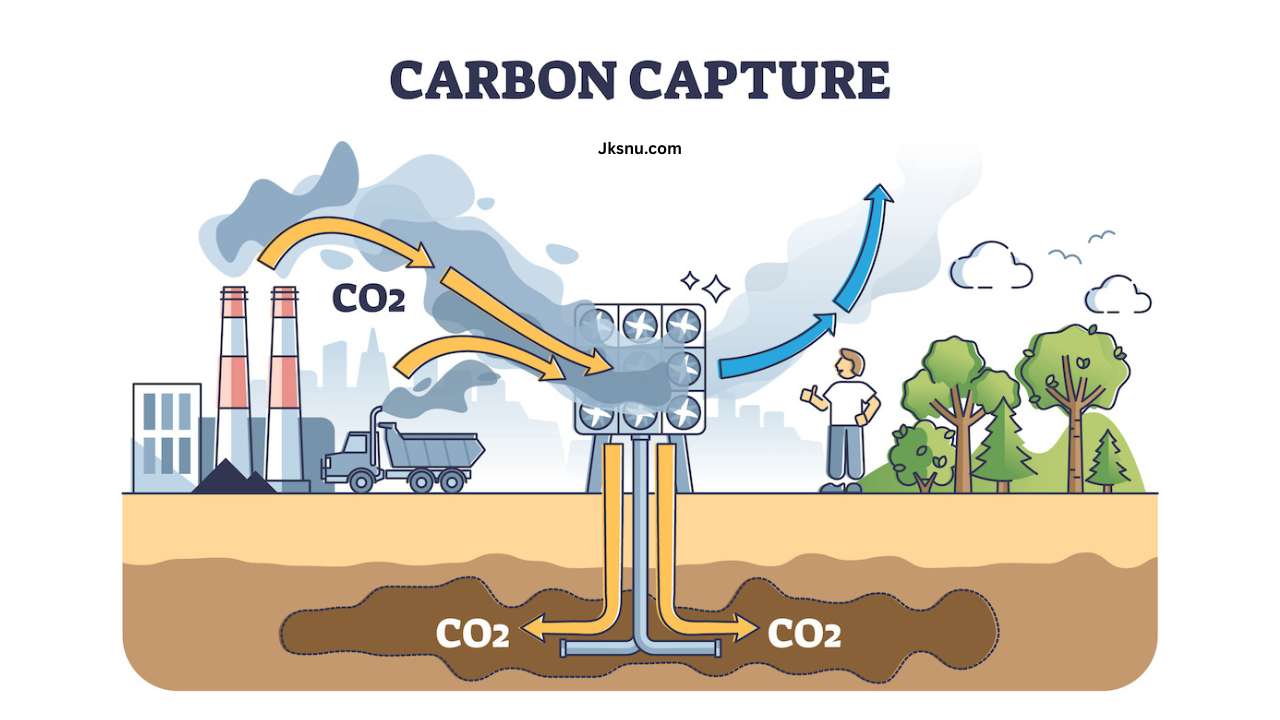
There are two broad categories: capturing CO₂ at the point of emission and capturing CO₂ directly from ambient air. Point-source capture focuses on flue gases from power plants or factories. The common technical routes include post-combustion capture, where CO₂ is chemically separated from exhaust gases; pre-combustion capture, where fuel is converted into a hydrogen/CO₂ mixture and the CO₂ is removed before combustion; and oxy-fuel combustion, where fuel is burned in oxygen so the exhaust is mainly CO₂ and water and is easier to separate. Direct air capture (DAC) pulls CO₂ from ambient air using sorbents or chemical processes. DAC operates at much lower CO₂ concentrations and so requires more energy per tonne removed, but it creates negative emissions when paired with permanent storage.
How capture methods work (technical snapshot)
Post-combustion systems commonly use chemical solvents such as amines that absorb CO₂ from flue gas; the solvent is then heated to release a concentrated CO₂ stream for compression and transport. Adsorption systems use solid materials — porous solids or metal-organic frameworks — that bind CO₂ and release it when heated, pressure-swung, or electrically regenerated. Membrane separation passes gas through selective membranes that preferentially allow CO₂ to cross. Cryogenic and physical separation methods compress and cool gases so CO₂ liquefies and can be removed. In DAC, air contactors move large volumes of air over sorbents; the sorbent is regenerated to obtain concentrated CO₂. Each method has tradeoffs in energy use, cost, footprint, and maturity.
Transport and storage options
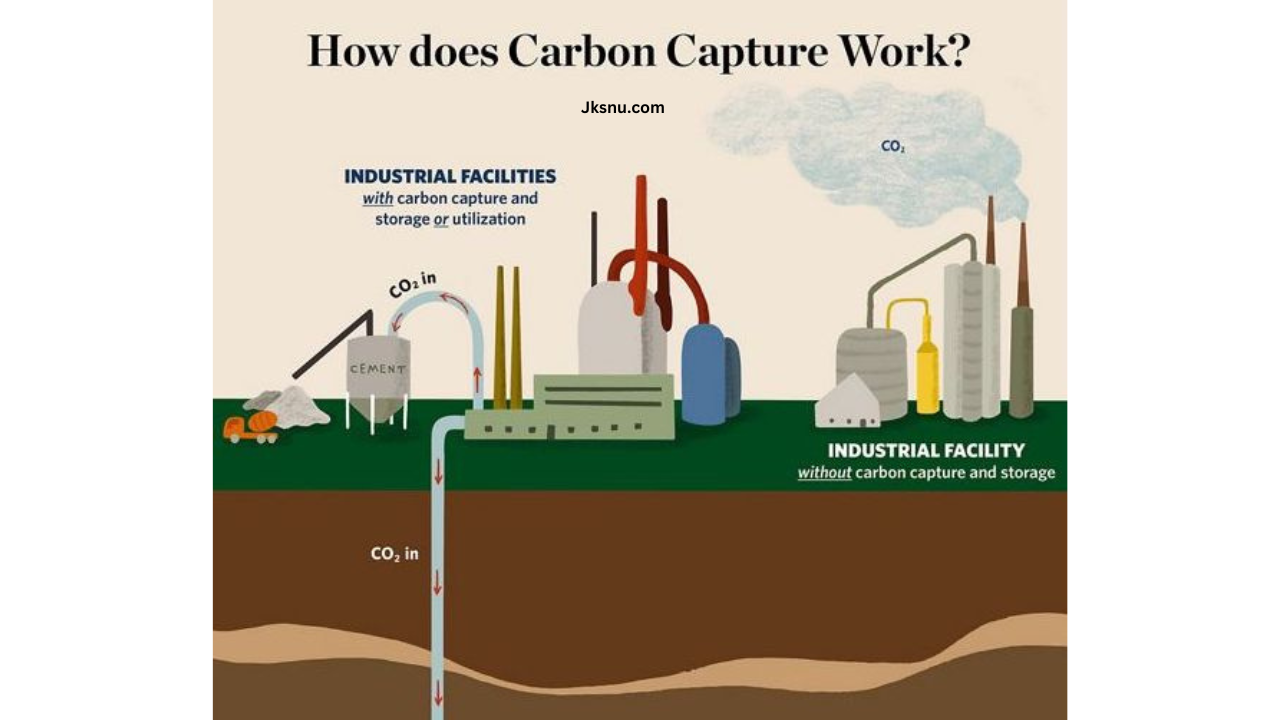
After capture, CO₂ is compressed and transported to storage or utilization sites. Pipelines are the most common and economical option for large, continuous CO₂ flows. Ships and trucks are used for smaller or dispersed sources or when pipeline infrastructure is unavailable. Storage typically aims for permanent geological sequestration deep underground in rock formations such as saline aquifers, depleted oil and gas reservoirs, or in certain basalt formations that enable mineralization. Injecting CO₂ into depleted hydrocarbon reservoirs can also enhance oil recovery, though that application complicates net emissions accounting. Another long-term storage route is mineral carbonation, where CO₂ reacts with silicate or basaltic rocks to form stable carbonates.
Utilization (CCU) versus permanent storage (CCS vs CDR)
Utilization converts captured CO₂ into products like synthetic fuels, chemicals, building materials (for example carbonated aggregates), or polymers. Conversion often requires additional energy and feedstocks; if the energy comes from fossil sources, overall emissions reductions may be limited. Utilization that results in a short product lifetime simply delays CO₂ release rather than permanently removing it. Permanent storage (often called CCS — carbon capture and storage) aims for multi-century sequestration in geological formations. The policy distinction matters: CCS at a fossil plant reduces emissions but may not create net negative emissions, whereas DAC coupled with permanent storage can produce net negative emissions.
Costs and energy penalties
Capturing CO₂ consumes energy and incurs costs for capture equipment, compression, transport, and monitoring. Point-source capture costs vary with the concentration of CO₂ in the gas stream and the scale of operations; higher CO₂ concentration (for example from industrial processes) makes capture cheaper and less energy intensive. DAC is more expensive because air contains only about 0.04% CO₂, so vast volumes of air must be processed. The “energy penalty” refers to extra energy the process needs, which reduces overall efficiency and can require larger power inputs. Falling unit costs are a major research and deployment focus, driven by materials innovation, process optimization, scale-up, and learning-by-doing.
Effectiveness and lifecycle considerations
The climate benefit of any capture project depends on full lifecycle accounting. If capture systems are powered by fossil energy, some of the captured CO₂ is offset by emissions from supplying the energy that runs the capture. To ensure meaningful emissions reductions, captured CO₂ should be stored permanently or the capture process should be powered by low-carbon energy. Monitoring, reporting, and verification of the quantity and permanence of stored CO₂ are essential to maintain environmental integrity.
Scalability and deployment status
Several commercial and demonstration projects around the world have proven that carbon capture can operate at industrial scale. Point-source CCS projects exist in power generation and heavy industry. DAC plants have been built but remain orders of magnitude smaller than the scale required to offset global emissions. Scaling to gigatonne-per-year levels will require massive investment in capture capacity, transport infrastructure like pipelines, and safe storage sites. Policy support, carbon pricing or credits, supply chains for equipment, and trained workforces are all needed to achieve rapid scale-up.
Risks and challenges
Key challenges include the high cost of capture (especially DAC), the energy intensity and associated emissions if powered by fossil fuels, the need for extensive pipeline and storage infrastructure, and local public acceptance concerns tied to CO₂ transport and injection. Permanence and leakage risk are often raised as concerns for geological storage, though careful site selection, injection practices, and long-term monitoring can mitigate risks. There is also a concern that heavy reliance on carbon capture could slow emissions reductions if it reduces incentives to phase out fossil fuels.
Policy frameworks and incentives
Government policy strongly influences deployment. Instruments that have driven activity include carbon pricing, tax credits or financial incentives for each tonne of CO₂ stored, government procurement of negative emissions, and regulations that require or encourage capture for certain industrial sectors. Public funding for research and demonstration helps push down costs. Corporate net-zero commitments and voluntary carbon markets also create demand for durable removal or avoidance credits, though high integrity standards are necessary to avoid greenwashing.
Examples and real-world use (selected illustrations)
Commercial CCS installations demonstrate capture at industrial facilities and storage in geological formations. Industrial projects capture CO₂ from chemical plants and refineries, while power sector examples have had mixed commercial outcomes. DAC companies have constructed modular plants to show the technology works, though current DAC capacity is small relative to global needs. These projects provide technical learnings, cost data, and operational experience that help make future deployments cheaper and more reliable.
Where research and innovation matter most
Research is rapidly advancing on lower-cost sorbents and solvents, more efficient and electrified regeneration approaches, modular and scalable DAC designs, CO₂-selective membranes, and integrated systems that combine capture with low-carbon hydrogen or renewable energy. Process integration to capture waste heat, novel catalysts for CO₂ conversion, and improved monitoring technologies for storage sites are also active research areas. Innovation that reduces the energy penalty and capital cost will be decisive for broad adoption.
Economics and business models
Different business models exist: capture as part of a utility or industrial operator, third-party capture and transport firms offering CO₂ removal as a service, and project developers focused on DAC plus permanent storage. Revenue streams include payments from emitters, sale of utilization products, government incentives, carbon credits, and contracts for difference or offtake agreements that underwrite long-term revenue. The viability of these models depends on the price of carbon, policy certainty, and the cost trajectory of capture technologies.
Environmental and social considerations
While carbon capture can reduce climate risk, it should not be used to justify continued high fossil fuel consumption without parallel emissions reductions. Local environmental impacts, land use for infrastructure, and community consent at storage sites need careful management. Equitable deployment should consider who bears relocation or risk and who benefits from jobs and investment.
Future outlook
If policy support and investment scale up, capture costs could fall substantially, enabling both large-scale CCS for industry and much larger DAC deployment for net-negative removals. Many climate pathways that limit warming to well below 2°C rely on some level of carbon removal in addition to deep emissions cuts. The speed and scale at which carbon capture can grow will be shaped by technology learning curves, public acceptance, robust regulation, and the availability of low-carbon energy to power capture processes.
Bottom line — when carbon capture makes sense
Carbon capture is a necessary tool for decarbonizing certain hard-to-abate industries and for achieving negative emissions via direct air capture plus permanent storage. It works best where CO₂ streams are concentrated, where secure geological storage is available nearby, and where low-carbon energy is available to power the process. It is not a substitute for rapid emissions reductions; rather, it complements other climate actions and will be most effective when deployed alongside strict rules, incentives for permanence, and transparent accounting.